Services
January 27, 2026
Amazon PPC Negative Exact vs. Negative Phrase: The Keyword Decision That Quietly Shapes Your Amazon PPC Performance
Services
January 27, 2026
Amazon PPC Negative Exact vs. Negative Phrase: The Keyword Decision That Quietly Shapes Your Amazon PPC Performance
Why Negative Exact Keyword Targeting Is One of the Most Underrated PPC Levers on Amazon
Most Amazon sellers know they should use negative keywords.
Very few use them correctly.
And even fewer understand why Negative Exact targeting often outperforms Negative Phrase when the goal is control, efficiency, and scalable growth.
This isn’t a tactical detail.
It’s a structural decision that directly impacts wasted spend, keyword discovery, and long-term account health.
Let’s break it down.
The Real Role of Negative Keywords in Amazon PPC
Negative keywords are not about “blocking traffic.”
They’re about shaping intent.
Every Amazon search represents a buying intent at a specific level:
Wrong format
Wrong dosage
Wrong use case
Wrong audience
Your job isn’t to eliminate traffic.
Your job is to filter the wrong intent without killing discovery.
This is where most sellers get it wrong.
Negative Phrase: Powerful, But Dangerous
Negative Phrase keywords block any search that contains that phrase in any order.
Example:
If you add “omega 3 gummies” as a negative phrase, Amazon will block:
omega 3 gummies for adults
best omega 3 gummies
kids omega 3 gummies
That sounds good… until it isn’t.
The problem with Negative Phrase:
It cuts too broadly
It blocks long-tail variations you might want to analyze later
It can silently kill future keyword expansion
It’s often used as a panic reaction to short-term spend
Negative Phrase is a blunt instrument.
Sometimes necessary—but rarely optimal by default.
Why Negative Exact Is the Smarter Default
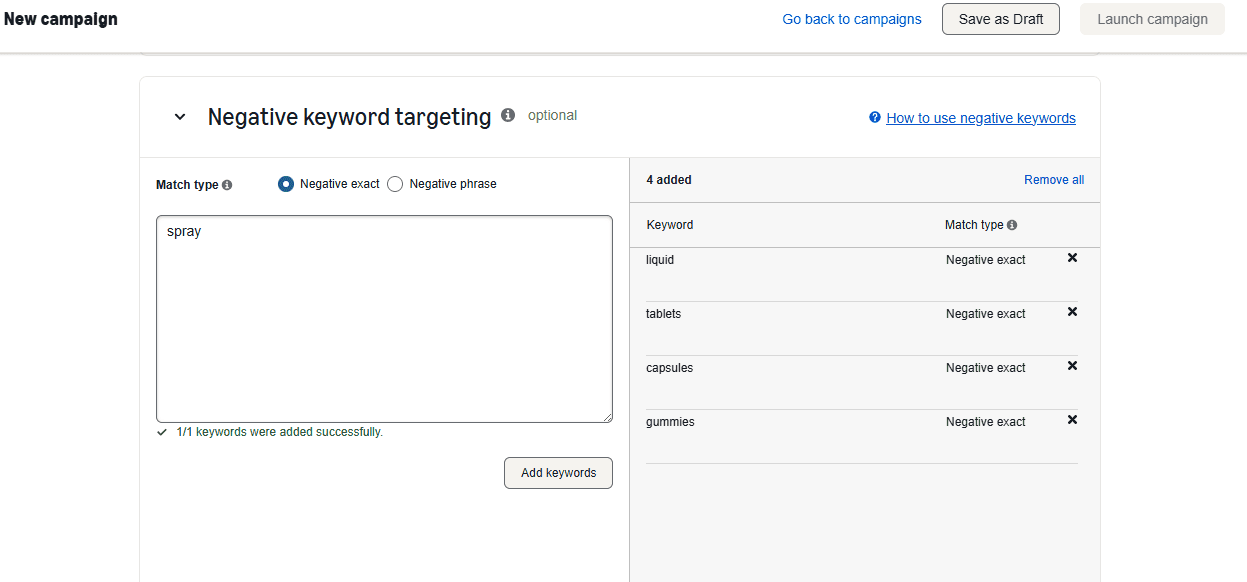
Negative Exact only blocks that exact search term, nothing more.
Example:
Negative Exact → “omega 3 gummies”
Blocked:
omega 3 gummies
Still allowed:
omega 3 gummies adults
omega 3 gummies sugar free
omega 3 gummies for heart health
This matters more than most sellers realize.
What Negative Exact gives you:
Precision control without over-filtering
Cleaner search term data
Better keyword discovery
Protection against accidental growth suppression
Scalability without chaos
Negative Exact doesn’t assume.
It waits for evidence.
When Negative Exact Is the Right Choice
Negative Exact should be your default when:
❌ The search term is clearly irrelevant (wrong form, wrong delivery, wrong product type)
📉 The term has spend + clicks but no realistic conversion path
🔬 You want to keep long-tail discovery alive
📈 You’re still scaling and refining intent signals
🧠 You’re making decisions based on patterns, not emotions
In short:
When you want control without collateral damage.
When Negative Phrase Actually Makes Sense
Negative Phrase isn’t bad—it’s just overused.
Use it when:
The entire phrase category will never convert
The product format is fundamentally incompatible
You’ve already validated there’s no long-tail value
You’re defending a mature account with stable demand
Negative Phrase is a scalpel only after diagnosis.
Most sellers use it like a hammer.
The Hidden Cost of Over-Negating
Overusing Negative Phrase leads to:
Artificially “good” ACOS
Shrinking impression volume
Starved algorithms
Slower ranking growth
Accounts that look efficient but don’t scale
If your PPC looks clean but sales are flat, this is often why.
The Core Principle Most Sellers Miss
Amazon PPC is not about blocking spend.
It’s about directing learning.
Negative Exact helps Amazon learn what not to prioritize
without preventing it from learning what could work next.
That difference compounds over time.
Final Thought
If your negative keyword strategy is based on:
Fear of spend
Short-term ACOS
“Cleaning up” reports
You’re optimizing for comfort, not growth.
At Chrizon Agency, we treat Negative Exact keywords as decision tools, not defensive moves.
Because on Amazon:
Precision beats aggression
Context beats rules
And data only matters when it drives the right decision
Why Negative Exact Keyword Targeting Is One of the Most Underrated PPC Levers on Amazon
Most Amazon sellers know they should use negative keywords.
Very few use them correctly.
And even fewer understand why Negative Exact targeting often outperforms Negative Phrase when the goal is control, efficiency, and scalable growth.
This isn’t a tactical detail.
It’s a structural decision that directly impacts wasted spend, keyword discovery, and long-term account health.
Let’s break it down.
The Real Role of Negative Keywords in Amazon PPC
Negative keywords are not about “blocking traffic.”
They’re about shaping intent.
Every Amazon search represents a buying intent at a specific level:
Wrong format
Wrong dosage
Wrong use case
Wrong audience
Your job isn’t to eliminate traffic.
Your job is to filter the wrong intent without killing discovery.
This is where most sellers get it wrong.
Negative Phrase: Powerful, But Dangerous
Negative Phrase keywords block any search that contains that phrase in any order.
Example:
If you add “omega 3 gummies” as a negative phrase, Amazon will block:
omega 3 gummies for adults
best omega 3 gummies
kids omega 3 gummies
That sounds good… until it isn’t.
The problem with Negative Phrase:
It cuts too broadly
It blocks long-tail variations you might want to analyze later
It can silently kill future keyword expansion
It’s often used as a panic reaction to short-term spend
Negative Phrase is a blunt instrument.
Sometimes necessary—but rarely optimal by default.
Why Negative Exact Is the Smarter Default
Negative Exact only blocks that exact search term, nothing more.
Example:
Negative Exact → “omega 3 gummies”
Blocked:
omega 3 gummies
Still allowed:
omega 3 gummies adults
omega 3 gummies sugar free
omega 3 gummies for heart health
This matters more than most sellers realize.
What Negative Exact gives you:
Precision control without over-filtering
Cleaner search term data
Better keyword discovery
Protection against accidental growth suppression
Scalability without chaos
Negative Exact doesn’t assume.
It waits for evidence.
When Negative Exact Is the Right Choice
Negative Exact should be your default when:
❌ The search term is clearly irrelevant (wrong form, wrong delivery, wrong product type)
📉 The term has spend + clicks but no realistic conversion path
🔬 You want to keep long-tail discovery alive
📈 You’re still scaling and refining intent signals
🧠 You’re making decisions based on patterns, not emotions
In short:
When you want control without collateral damage.
When Negative Phrase Actually Makes Sense
Negative Phrase isn’t bad—it’s just overused.
Use it when:
The entire phrase category will never convert
The product format is fundamentally incompatible
You’ve already validated there’s no long-tail value
You’re defending a mature account with stable demand
Negative Phrase is a scalpel only after diagnosis.
Most sellers use it like a hammer.
The Hidden Cost of Over-Negating
Overusing Negative Phrase leads to:
Artificially “good” ACOS
Shrinking impression volume
Starved algorithms
Slower ranking growth
Accounts that look efficient but don’t scale
If your PPC looks clean but sales are flat, this is often why.
The Core Principle Most Sellers Miss
Amazon PPC is not about blocking spend.
It’s about directing learning.
Negative Exact helps Amazon learn what not to prioritize
without preventing it from learning what could work next.
That difference compounds over time.
Final Thought
If your negative keyword strategy is based on:
Fear of spend
Short-term ACOS
“Cleaning up” reports
You’re optimizing for comfort, not growth.
At Chrizon Agency, we treat Negative Exact keywords as decision tools, not defensive moves.
Because on Amazon:
Precision beats aggression
Context beats rules
And data only matters when it drives the right decision
Blogs
Other Blogs
Check out our blogs for useful information for your Amazon business
Blogs
Other Blogs
Check out our blogs for useful information for your Amazon business